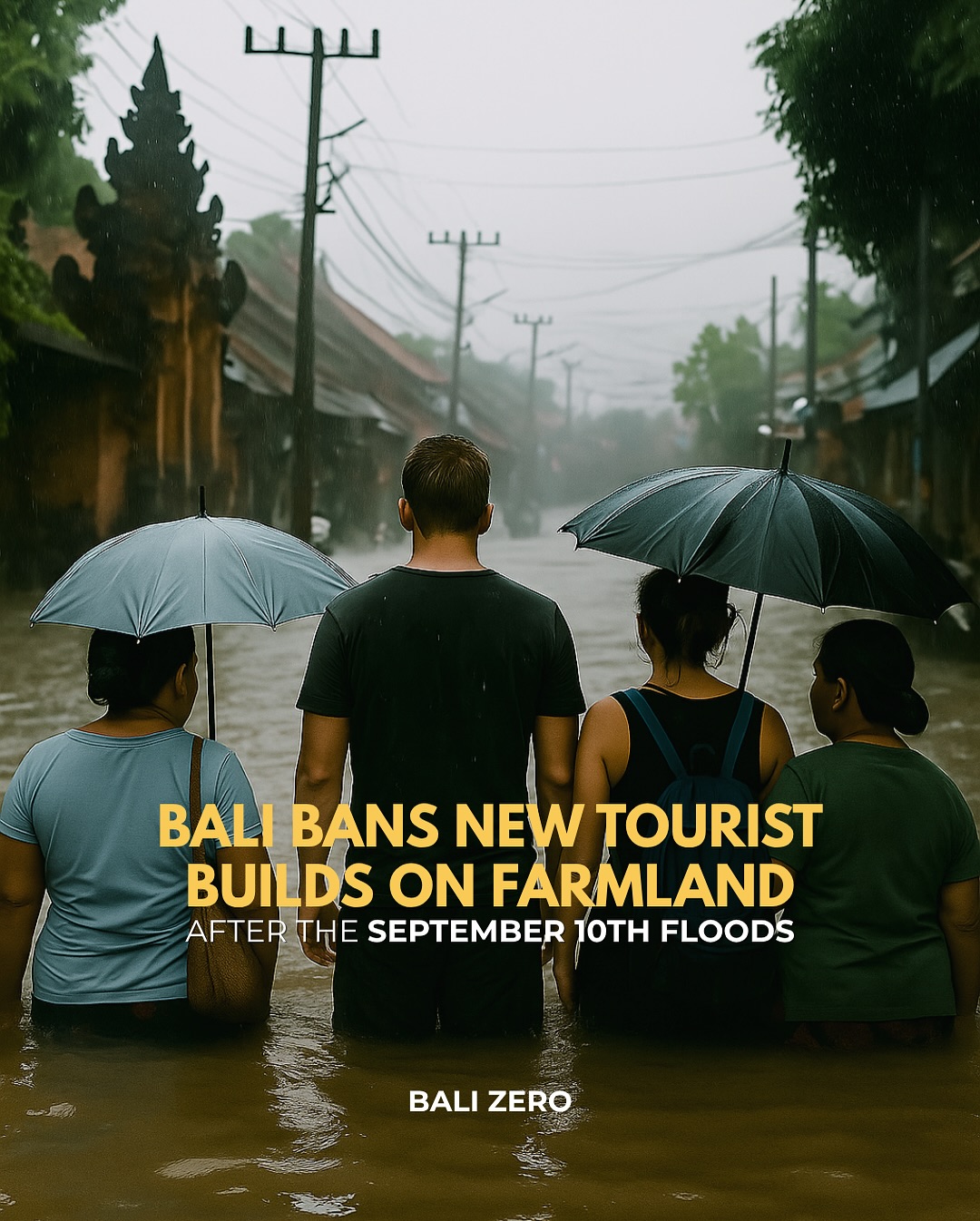
18 lives lost. 81 neighborhoods submerged. September's floods exposed the deadly cost of unchecked development. Did overtourism and illegal building kill Bali's rice terraces—and with them, the island's flood defenses?
Bali's Reckoning: When Paradise Drowns, Who's to Blame?
18 lives lost. 81 neighborhoods submerged. And a question Indonesia can no longer ignore: Did we build paradise to death?
The Night the Water Came
September 10th, 2025. The rain started at 2 AM.
By dawn, the Unda River had breached its banks. Mudslides swallowed homes in Karangasem. Flash floods turned Denpasar's southern districts into brown-water lakes. Eighteen people were dead. Thousands huddled on rooftops, watching their lives float away.
A rice farmer in Gianyar stood knee-deep in what used to be his terraced paddy. He'd lived there 40 years.
"The floods used to come maybe once every five years," he said. "Now? Twice a season. And each time, they take more."
The numbers tell the story the government doesn't want to hear: 81 areas underwater. 23,000 residents displaced. IDR 4.7 billion in infrastructure damage. And beneath those statistics, a harder truth—this wasn't a natural disaster. This was a bill coming due.
The Concrete Tide Nobody Stopped
Bali's transformation from sleepy island to global destination has been nothing short of miraculous. In 2019, 6.3 million foreign tourists visited. By 2024, that number had nearly doubled to 11.8 million—more visitors than Bali has residents.
But miracles have costs.
Between 2015 and 2025, over 2,400 hectares of rice terraces were converted to tourism infrastructure—hotels, villas, beach clubs, and the endless parade of trendy cafes that fuel Instagram's vision of tropical living. That's roughly the size of 3,360 football fields of rice paddies, paved over in a decade.
"Every rice field absorbs water like a sponge," explained Dr. Sudiana, an environmental hydrologist at Udayana University. "When you replace that with concrete, the water has nowhere to go. It doesn't just run off—it accelerates. And when it hits a river or drainage system that was never designed for that volume, you get catastrophic flooding."
The problem isn't just tourism. It's illegal building. It's unenforced regulations. It's foreign investors who don't understand—or don't care—that those emerald rice terraces aren't decorative. They're Bali's kidneys.
Subak: The 1,000-Year-Old System We Forgot
Long before Bali had a tourism industry, it had Subak—a UNESCO-recognized irrigation system that dates back to the 9th century. Subak isn't just about watering crops. It's a philosophy: water flows from mountains to the sea, and every farmer, every village, every temple along that path is a custodian.
The rice terraces aren't farmland. They're flood control systems. They're aquifer recharge zones. They're what kept Bali habitable for a millennium before anyone thought to build a five-star resort on them.
"Subak is tri hita karana—harmony between humans, nature, and the divine," said a Subak cooperative leader in Tabanan. "When you destroy a rice field to build a villa, you're not just removing crops. You're breaking a cycle that's existed for 1,000 years. And cycles don't forgive."
Since 2012, when UNESCO declared Subak a World Heritage Cultural Landscape, Bali has lost 31% of its irrigated rice land. The designation came with international prestige. It didn't come with enforcement.
The Government Finally Blinks
Two days after the floods, Governor Wayan Koster announced an emergency moratorium: no new tourism construction on agricultural land or green zones. Existing permits would be reviewed. Violators would face sanctions.
On paper, it sounded decisive. In practice, it raised more questions than it answered.
"Which permits are we reviewing?" asked a Denpasar-based property lawyer. "Half the villas in Canggu were built on land that was 'technically agricultural' five years ago. Are we tearing those down? And who's enforcing this when local officials have been approving permits they shouldn't have for the past decade?"
The law is clear: Indonesian land-use regulations prohibit tourism construction on rice fields classified under Lahan Pertanian Pangan Berkelanjutan (LP2B)—sustainable food agricultural land. The problem? Enforcement has been selective at best, corrupt at worst.
A 2024 investigation by Tempo Magazine found that 42% of tourism developments in Badung regency were built on land that had been reclassified from agricultural to commercial use within six months of purchase—often through "administrative adjustments" that involved undisclosed payments to district officials.
The Overtourism Debate Nobody Wants to Have
Tourists didn't cause the floods. But tourism created the conditions that made them catastrophic.
Bali's infrastructure was built for 4 million people. It now hosts 15 million annually, plus a growing population of remote workers, expats, and long-term tourists blurring the line between visitor and resident.
"We're at capacity," said I Wayan Kasa, head of Bali's environmental agency BLHK. "Our waste management systems are overloaded. Our aquifers are being drained faster than monsoons can refill them. And every time we approve a new hotel, we're choosing short-term revenue over long-term sustainability."
The economic argument for tourism is undeniable. Bali's tourism sector contributes IDR 78 trillion annually to the local economy—roughly 60% of the island's GDP. Hotels employ tens of thousands. Restaurants, transport, guides, artisans—entire villages depend on the industry.
But the cost?
- 40% of Bali's coastal aquifers are now saline due to over-extraction
- Denpasar's water table drops 1-2 meters annually
- Traffic congestion costs IDR 2.1 trillion per year in lost productivity
- Solid waste generation has tripled since 2010, overwhelming landfills
"We can't keep sacrificing our environment for tourism dollars," said environmental activist Melati Wijsen, co-founder of Bye Bye Plastic Bags. "Tourists come here for the beauty. When the beauty's gone, they won't come back."
The Question Jakarta Doesn't Want to Answer
Indonesia's national government has a delicate dance to perform. Tourism is the country's third-largest source of foreign exchange, generating $19.3 billion in 2024. President Prabowo's administration has pledged to double that by 2029.
But climate scientists warn that Bali's current trajectory isn't just unsustainable—it's catastrophic.
A 2024 study by the Indonesian Institute of Sciences (LIPI) projected that if construction continues at current rates, Bali will experience annual severe flooding by 2030. Not "if." When.
"The government faces a choice," said Dr. Emil Salim, former Indonesian Environment Minister. "Do we want short-term tourism growth that destroys the island tourists come to see? Or do we want sustainable development that keeps Bali livable for the next 100 years?"
So far, Jakarta's answer has been: both. And neither.
The moratorium on new builds is a start. But Bali needs more than reactive policy. It needs comprehensive zoning reform. It needs strict enforcement of LP2B protections. It needs to ask wealthy investors a question they're not used to hearing:
No.
What Happens Next
Bali stands at an inflection point. The floods were a wake-up call. The question is whether Indonesia is awake.
Local governments have promised stricter building codes. Environmental groups are demanding criminal prosecution for illegal developers. Tourism associations are exploring "regenerative tourism" models that give back more than they take.
But policy alone won't fix this.
"Change has to come from the top and the bottom," said a Subak elder in Ubud. "The government needs to enforce laws. But tourists, investors, expats—they need to understand. Rice fields aren't real estate. They're life support systems. And when you destroy them, you destroy Bali."
The September floods killed 18 people. The next ones will kill more. The only question is whether Bali will change before the water comes back.
The Investor's Dilemma
For foreign entrepreneurs looking to build in Bali, the new reality is complex. The moratorium isn't retroactive, but it signals a shift. Future developments will face scrutiny. Permits that once took weeks may take months—or be denied outright.
"Responsible investment in Bali is still possible," said a sustainable development consultant in Bali. "But it requires understanding local regulations, respecting LP2B zones, and working with communities—not against them."
That's where expertise matters.
Navigating Bali's post-flood regulatory landscape requires local knowledge, legal precision, and a commitment to sustainable development. Whether you're planning a business, purchasing property, or establishing a long-term presence in Indonesia, understanding the new rules isn't optional—it's essential.
Need help navigating Indonesia's changing regulatory environment? Bali Zero specializes in compliant, sustainable business setup for entrepreneurs who want to invest responsibly. From company formation to property advisory to visa solutions, we help you build in Bali the right way—legally, ethically, and for the long term.
📲 Connect with Bali Zero's expert team and invest in Bali's future, not its destruction.
Header image: Flooded rice terraces in Gianyar, September 11, 2025. Source: Instagram @balizero0
Premium business intelligence for Southeast Asia

